

A floor covers every room you walk into, so choosing one deserves a slower look than a weekend sale allows.
This guide slows it down. No hype, no invented scores — just the checks that help you decide whether this popular rigid-core vinyl plank suits your rooms, your routine and your budget.
1. Quick Answers: The Questions Every Buyer Asks First
If you have spent any time reading smartcore pro reviews, you will know the conversation tends to circle the same handful of questions. Is it genuinely waterproof or merely water-resistant in daily life? How does it feel and sound underfoot? Can it go over an existing floor? What happens in a sunny room, a cold room or a busy hallway? The honest answer to each one is: it depends on your space, your subfloor and how carefully the planks are fitted. That is why this guide is organised as a series of checks rather than a verdict stamped at the top.
Start with the quick answers below, which summarise the sensible position on each common question without pretending to laboratory certainty. Then work through the sections that follow, each of which turns one question into a set of things you can look at, measure, ask or test before money changes hands. Flooring is a decade-long decision wearing a one-day price tag, so an hour of checking now is cheap insurance.
| Question | What to Check |
|---|---|
| Is it right for kitchens and bathrooms? | Rigid-core vinyl is generally chosen for splash-prone rooms, but check the maker’s room guidance and how seams and edges will be finished in your layout. |
| Can it go over my existing floor? | Only over a firm, flat, dry base. Check flatness, moisture and door clearances before assuming a shortcut. |
| How will it feel underfoot? | Handle a plank, walk on a fitted display if you can, and consider what underlay or attached backing the line uses. |
| Will the colour match my room? | View full planks at home in daylight and lamplight; small samples and screen photos routinely mislead. |
| What will the whole job cost? | Think beyond the box price: underlay, trims, thresholds, fitting and waste allowance all belong in the same budget. |
| What if a plank gets damaged later? | Keep spare planks from the same batch and confirm how single-plank replacement works for a click-fit floor. |
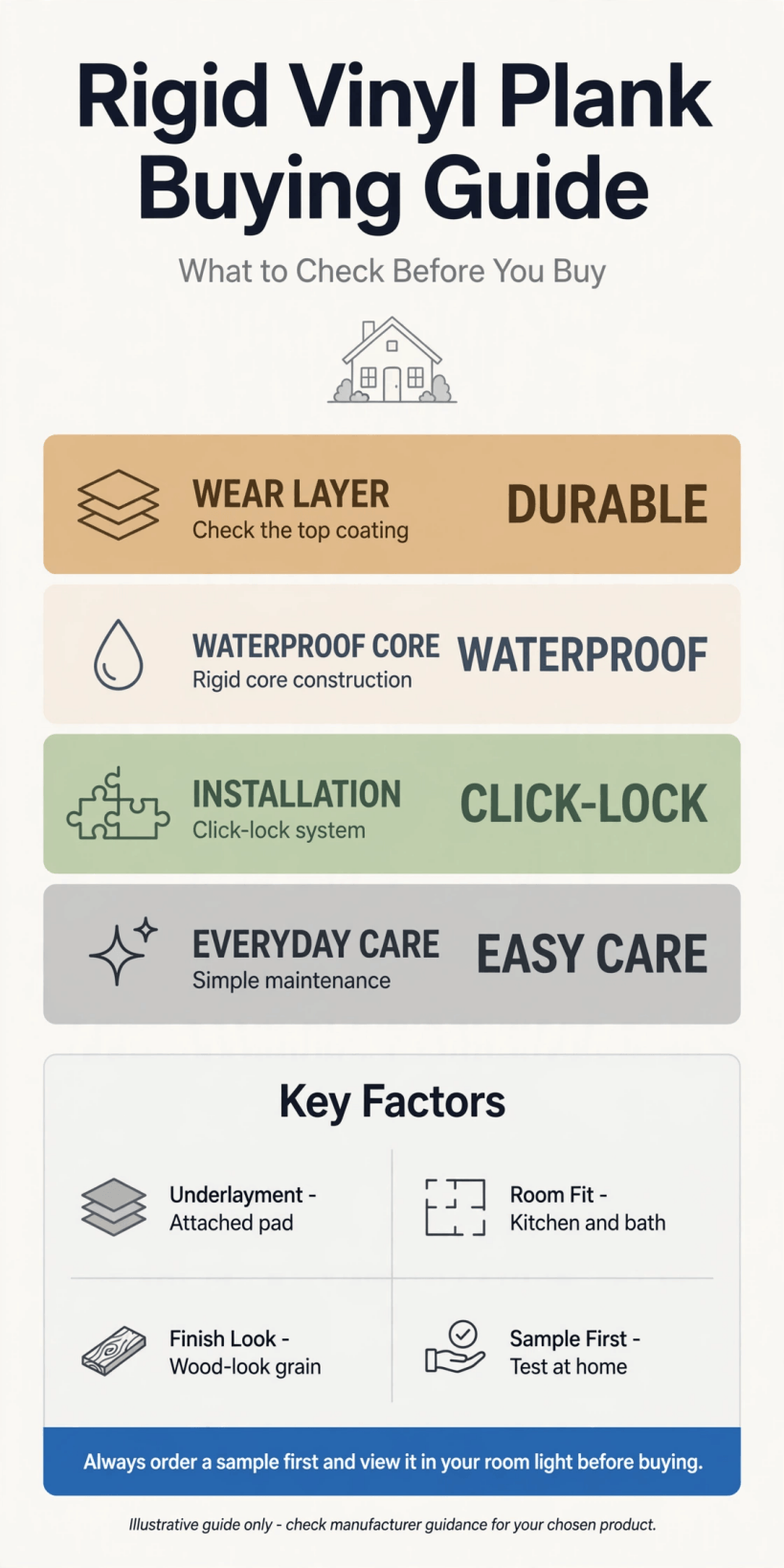
The pre-buy checklist at a glance: the box, the room, the fit and the paperwork.
A final word before the detail: treat every confident claim you meet — in a showroom, a listing or a comment thread — as a prompt to verify, not a fact to file. The checks below are deliberately ordinary. None needs special equipment, and together they catch the great majority of expensive surprises.
2. What This Flooring Is, in Plain Terms
SmartCore Pro is a popular rigid-core vinyl plank line: individual planks with a stiff, stable core, a printed wood-look surface and a click-together edge profile, designed to be laid as a floating floor rather than glued or nailed down. That one sentence explains most of its appeal. Rigid-core planks are generally chosen by people who want the look of wood with a surface that shrugs off everyday spills, grit and chair legs more forgivingly than many natural materials, and who like the idea of a floor that can be fitted room by room.
Plain terms also mean honest limits. A printed surface, however well done, repeats its pattern along the plank, and a floating floor is only ever as good as the flat, dry base beneath it. If you are comparing heating options for a hard floor, our guide to underfloor heating in tiny houses is a useful companion read, because any pairing of heat and flooring deserves a compatibility check with the maker before you commit. Keep the plain-terms picture in mind — a practical, manufactured floor with real strengths and ordinary trade-offs — and the rest of this guide becomes a matter of verifying the fit for your home.

3. Where It Tends to Work Well
Patterns emerge when you look at where rigid-core vinyl plank is most often chosen. Busy living rooms, hallways that take muddy shoes, kitchens where splashes are a daily event, and small homes where one floor runs through several zones all feature again and again. The common thread is a household that wants one continuous, easy-clean surface and does not want to tiptoe around it. In compact spaces especially, a single plank tone running from door to far wall can make the whole footprint feel calmer and larger.
It is also a frequent pick for rooms that sit between certainties: a basement-level space that is dry but cool, a rental that needs refreshing, a first renovation where the budget has to cover furniture too. None of that guarantees it suits your rooms. Sun-drenched spaces deserve a specific check on fading guidance, heavy point loads such as pianos or large appliances deserve a question about indentation, and any room with a history of damp deserves a moisture investigation first, whatever floor you favour. The sections ahead turn each of those situations into a concrete check.
4. Check the Planks Themselves: What to Inspect in the Box
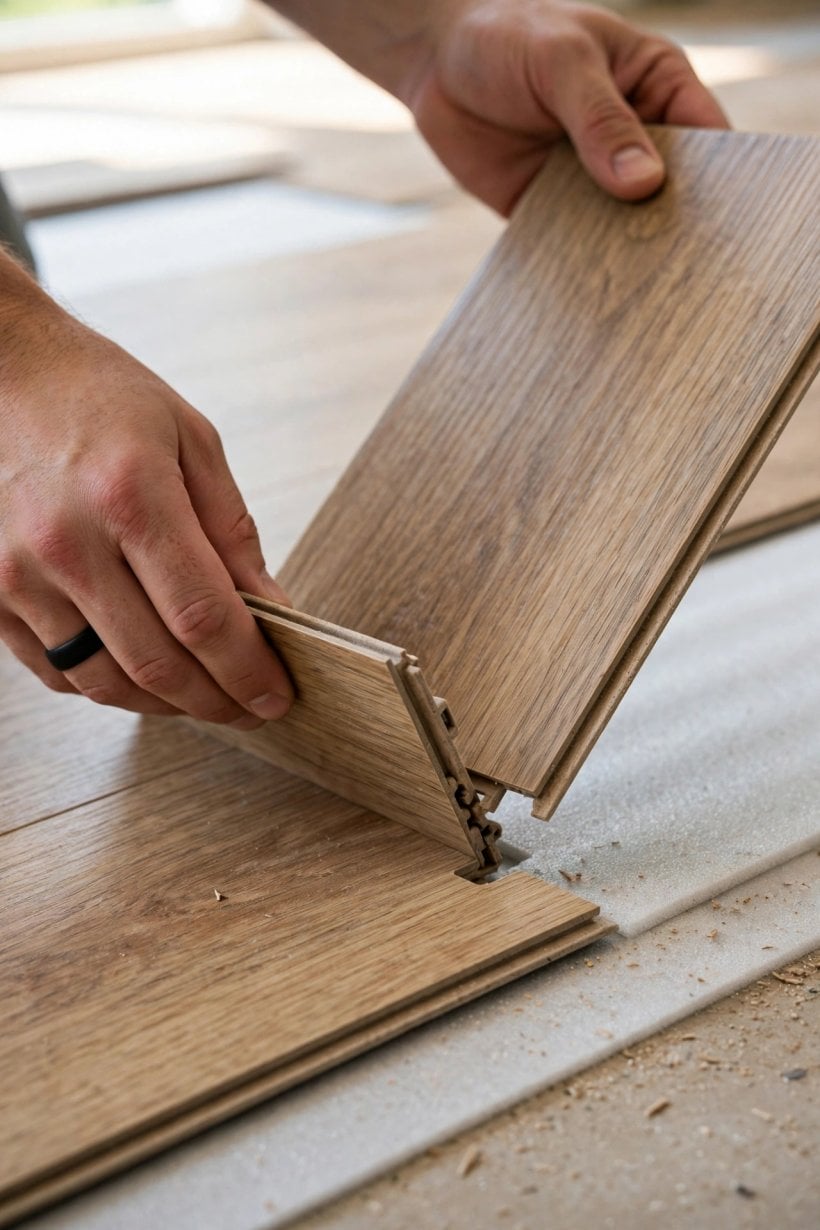
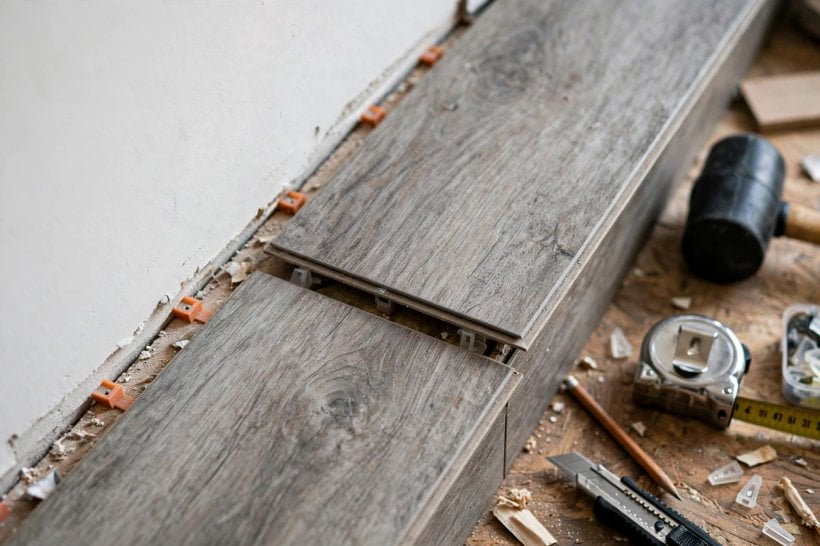
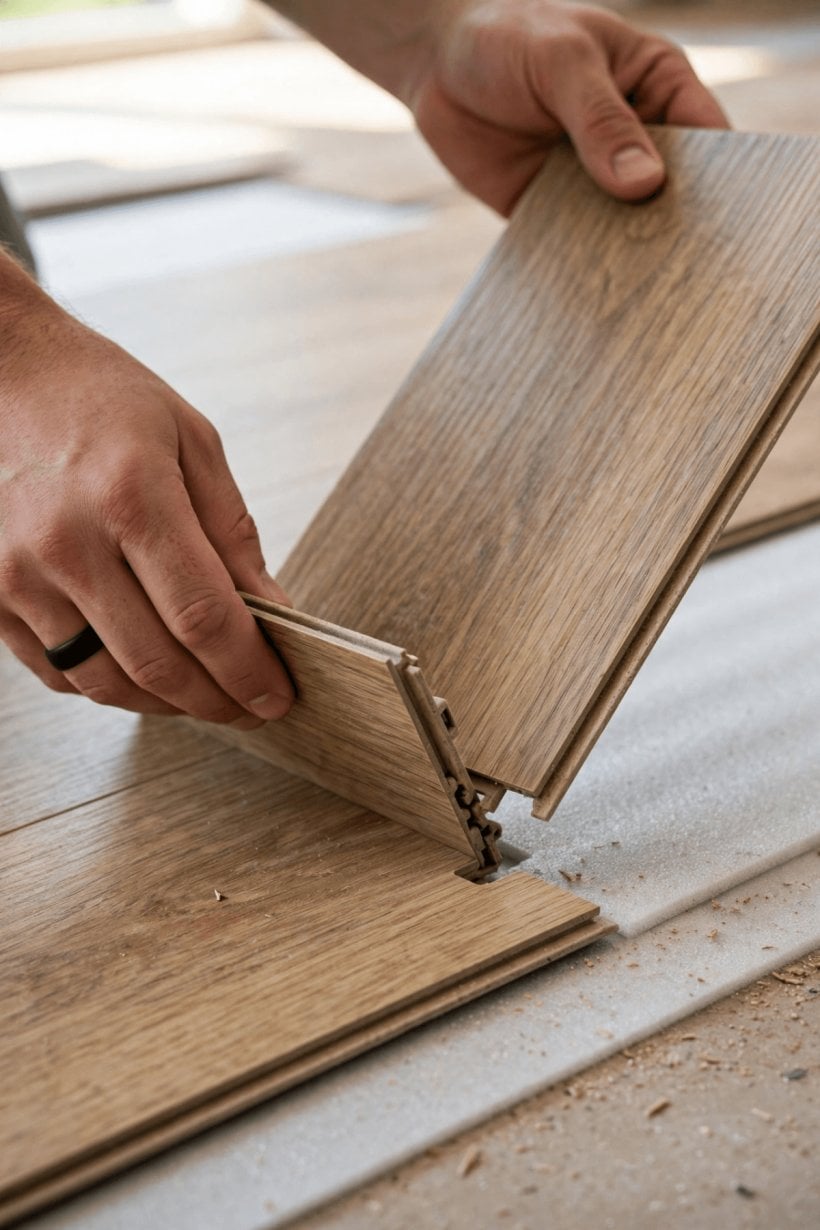
Before you judge a floor by a showroom board, handle the real thing. Open a box — or order full planks rather than a swatch — and look along each plank for straightness, then click two together on a flat surface. The joint should close neatly without force or visible gaps, and the surface pattern should align in a way that looks natural to your eye. Turn a plank over: the backing, if one is attached, should be even and firmly bonded, with no bubbling or lifting at the corners.
Colour deserves its own moment. Lay several planks side by side, because tone varies slightly between pieces in most wood-look floors, and decide whether that variation reads as character or as patchiness in your light. Carry the planks to the actual room at different times of day. If the floor will continue into a wet zone, the layout thinking in our guide to tiny house bathroom layouts helps you plan where plank runs should stop and trims should start. Finally, count what is actually in a box and confirm the coverage the seller states, so your quantity maths rests on the product in front of you rather than on a generic assumption.
5. Check Your Room: Subfloor, Moisture and Light
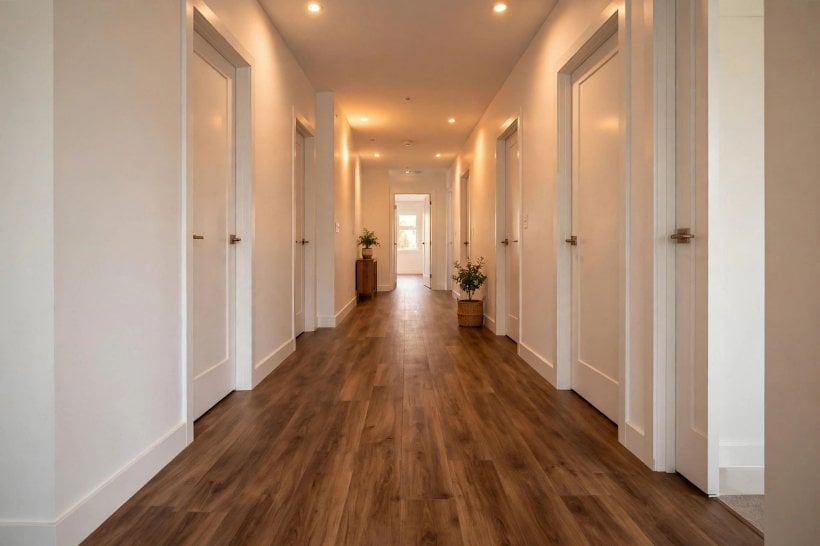
More floating floors disappoint because of the room than because of the plank. Start with flatness: lay a long straightedge across the subfloor in several directions and look for dips or humps, since a rigid plank bridges small imperfections but can flex, creak or stress its joints over big ones. Note what the existing base is — boards, concrete, old vinyl — and whether it is firm everywhere, especially near doorways and along outside walls.
Moisture is the second check, and it is non-negotiable in ground-floor and below-grade rooms. Look for the obvious signs first: tide marks, musty smells, lifting old flooring, damp skirting. If anything raises a question, have the subfloor properly tested before the new floor goes down, and follow the maker’s guidance for any moisture barrier or underlay your situation needs. Light is the third check and the easiest: strong directional sunlight will show every joint and can warm a floor considerably, so view your sample planks in the sunniest corner as well as the shadiest. The same room-first thinking drives good tiny house kitchen ideas, where one hard-working surface has to suit cooking, dining and daily traffic at once.
6. Check the Fit: Trims, Thresholds and Awkward Corners
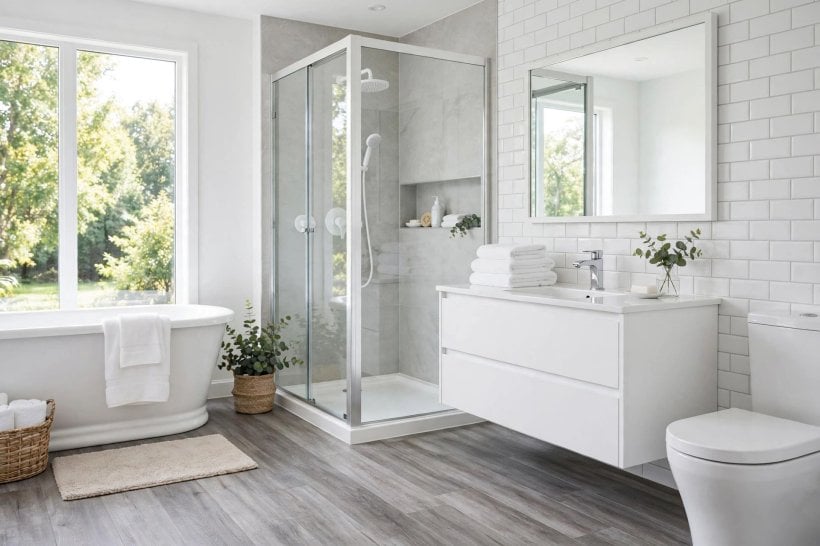
A floor is finished at its edges, and edges are where budgets and tempers fray. Walk your room with a tape and list every edge the new floor will meet: doorways to other rooms, a hearth, patio doors, kitchen units, a staircase if one is involved. Each junction needs a plan — a threshold profile, a scotia or skirting solution, an expansion gap that stays covered — and each plan belongs on the shopping list before the planks are ordered, not discovered on fitting day.
Heights matter as much as lengths. A new plank build-up changes the floor level slightly, which can mean doors that suddenly catch, appliances that no longer slide under a worktop, or a trip lip where two rooms meet. Measure the build-up of plank plus underlay against your tightest clearance and adjust the plan while it is still a plan. Awkward corners, chimney breasts and bay angles all increase cutting and waste, so note them honestly when you calculate quantities. None of this is glamorous, yet a floor whose edges are solved looks twice as expensive as the same floor fitted hopefully and trimmed later.

7. Check the Whole Cost Picture, Not Just the Box Price
Price talk for flooring is most useful when it stays qualitative and complete. The box price is only the first line. Underlay, if your chosen build-up needs it, is a second. Trims, thresholds and finishing profiles are a third that is routinely forgotten. Fitting is a fourth — whether that is your own weekend, which costs time and a few tools, or a professional installer, whose quote should state exactly what preparation is and is not included.
Add a sensible waste allowance for cuts and the occasional damaged plank, delivery charges if they apply, and the cost of lifting and disposing of the old floor. Set against that fuller picture, the honest question becomes comparative: does this line, fully installed in your room, sit comfortably against the alternatives you genuinely like, at a figure you can carry without raiding the budget for everything else the room needs? Resist the opposite traps of judging on box price alone and of assuming that paying more per box automatically buys a better result in your space. In small homes especially, money saved by clear-eyed checking can fund the lighting or storage that finishes the room — the balance we explore in our tiny house and small-space interior design guide.
8. Check the Paperwork: Batches, Returns and Care Notes
Paperwork is the least exciting check and the one people most wish they had done. Before ordering, confirm that your full quantity can come from one production batch, since tone can shift subtly between batches, and ask how the seller handles a box that arrives damaged or a shade that looks wrong on opening. Keep the delivery paperwork and one box label until the floor is finished and you are satisfied, because batch references are what make a later top-up order match.
Read the care notes that come with the product rather than assuming them. Which cleaners are approved, whether steam mops are welcome or forbidden, what felt pads are recommended under furniture, and how soon heavy items can go back onto a new floor — these small instructions protect the surface you have just paid for. Keep a few spare planks from the same batch in a dry corner of the home; a click-fit floor with spares on hand turns a future accident into a repair instead of a hunt for a discontinued shade. And if a warranty is part of the sales conversation, read its actual conditions — what it covers, what it excludes and what installation steps it requires — in the maker’s own document, not in a summary.
9. Alternatives Worth Comparing Before You Decide
A decision you have compared is a decision you can trust. Before committing, put this rigid-core plank beside the realistic alternatives for your room and run the same checks on each. Laminate is the closest cousin: often a little crisper underfoot and worth testing for how it handles your room’s moisture risks. Sheet vinyl is the budget-friendly all-rounder, seamless in small wet rooms but a different look entirely. Luxury vinyl tile in other formats, engineered wood for those who want a real timber surface, and simply repairing or refinishing an existing floor all belong in an honest comparison.
Compare like with like: the fully installed picture, the feel under your own feet, the colour in your own light, and the maintenance you will actually keep up with. A short, deliberate comparison also protects you from the two most common regrets — buying the first floor you saw, and buying the floor that suited someone else’s house. If you gather inspiration while you compare, our collection of smart tiny house design ideas shows how often the winning floor is the one chosen as part of a whole-room plan rather than in isolation.
10. A Calm Verdict: Who Should Buy and Who Should Wait
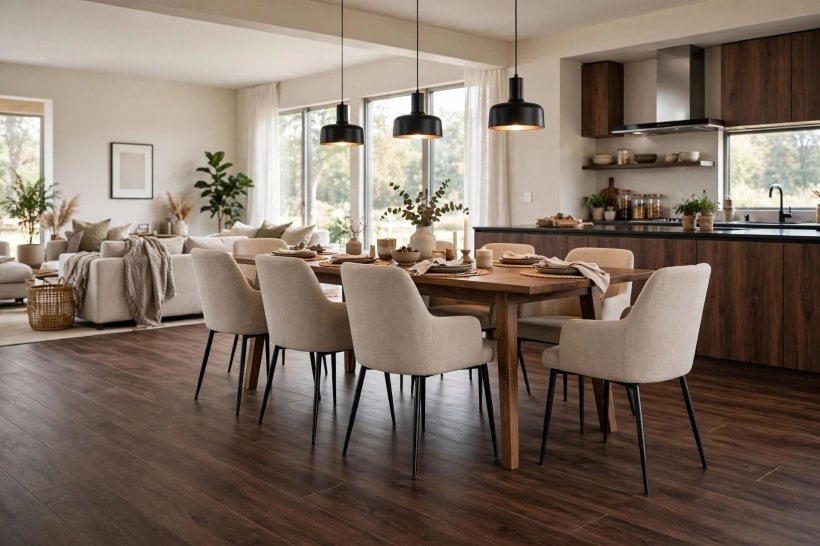
So, is it worth it? Gather enough smartcore pro reviews together and the balanced answer is that this rigid-core plank line earns its popularity when the fit is right: a household that wants a wood-look, easy-care, floating floor; rooms that are dry, reasonably flat and honestly measured; and a buyer who has handled the planks and priced the whole job, edges included. On those conditions, it is a sensible, attractive choice that many owners live with happily.
Wait, on the other hand, if your subfloor has unresolved damp, if the room’s levels and doorways have not been measured against the build-up, or if you are choosing from a phone screen’s colour alone. None of those are problems with the product; they are problems with the moment. Fix the base, borrow or buy full planks to live with for a few days, and revisit the decision with the checklist in hand. Flooring rewards the patient: the checks in this guide take an afternoon, and the floor they protect is one you will walk on for years. For a final dose of whole-room perspective, browse our favourite tiny house interior design ideas and picture the floor as the quiet foundation it is meant to be.
Final Considerations
Treat this guide as a checklist, not a sales pitch. The product is a popular rigid-core vinyl plank line with genuine strengths for busy, splash-prone, hard-working rooms — and like every floor, it performs best over a sound base, in a room it suits, fitted with its edges properly finished. Verify the specifics that matter for your home with the maker and the seller, in writing where it counts, and let your own eyes, hands and tape measure have the final say. Choose calmly, and the floor under everything else in the room will quietly do its job for a long time.


0 Comments