

Building a tiny house is the easy part. Finding a legal, affordable place to put it — in a climate you enjoy — is where most tiny dreams stall. This tiny house living quiz turns that overwhelming question into five answers and one clear recommendation.
The Tiny House Location Matcher below weighs your answers and deals you a Match Card for one of seven tiny-friendly US regions. Here is how it works — and how to use your result.
1. At a Glance: Seven Regions, Five Questions, One Match Card
The matcher keeps things deliberately simple. You answer five multiple-choice questions — climate, land budget, lifestyle vibe, legality preference and connectivity — and the tool compares your answers against seven US regions known for being tiny house friendly. Each answer carries a different weight (more on that in section 8), and the region that scores highest appears on your Match Card with a percentage match, its climate, its legality status and a short description. These are the seven places it can send you:
| Match Location | Climate | Legality | How the Tool Describes It |
|---|---|---|---|
| Asheville, NC | Temperate | Very Friendly | The tiny house capital of the East, in the Blue Ridge Mountains |
| Austin / Hill Country, TX | Hot/Humid | Friendly (ADUs) | Warm weather and home to Community First! Village |
| Front Range, CO | Cold/Alpine | Specific Zones | Outdoor paradise for skiers and hikers |
| Pima County, AZ | Desert | Code Approved | Progressive tiny house building codes (Appendix Q) |
| Portland, OR | Rainy/Mild | ADU Legal | The original tiny house city, built around backyard ADUs |
| Central Florida | Tropical | RV Parks | No snow, ever — and affordable outside major cities |
| Vermont | Cold/Snowy | Lax Enforcement | Beautiful seasons and a “live and let live” attitude |
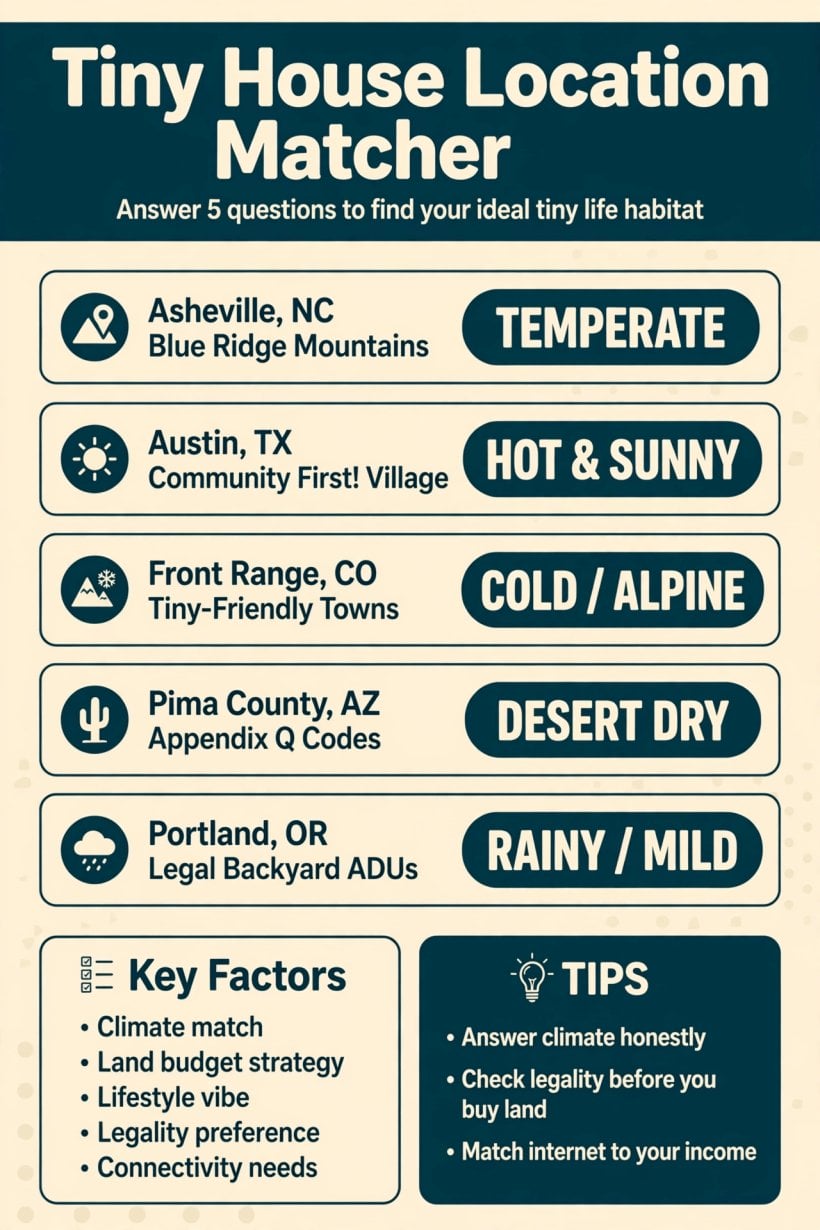
The seven possible results of the Tiny House Location Matcher — from Blue Ridge mountain towns to a desert county with tiny house codes — and the climate and legality profile the tool assigns to each.
No result is a sales pitch. The matcher is a recommendation engine, not a booking tool: it narrows a whole country’s worth of options down to the one region whose weather, rules and lifestyle fit the answers you gave. Treat the match as your research starting point. Sections 2 to 7 walk through each question, section 8 opens up the scoring, section 9 tours every possible result, and section 10 explains what to verify before you commit to a move.
2. Location: The Decision That Outlasts the Build
The matcher states its premise right up front: finding a place to live is harder than building the house. That rings true for almost everyone who goes tiny. A floor plan can be redrawn in an afternoon, a trailer can be hitched up and moved in a day, but climate, land prices, zoning attitudes and community culture are fixed to the map. Pick the wrong region and even a perfect house feels like a daily compromise; pick the right one and everything from your heating bills to your social life gets easier.
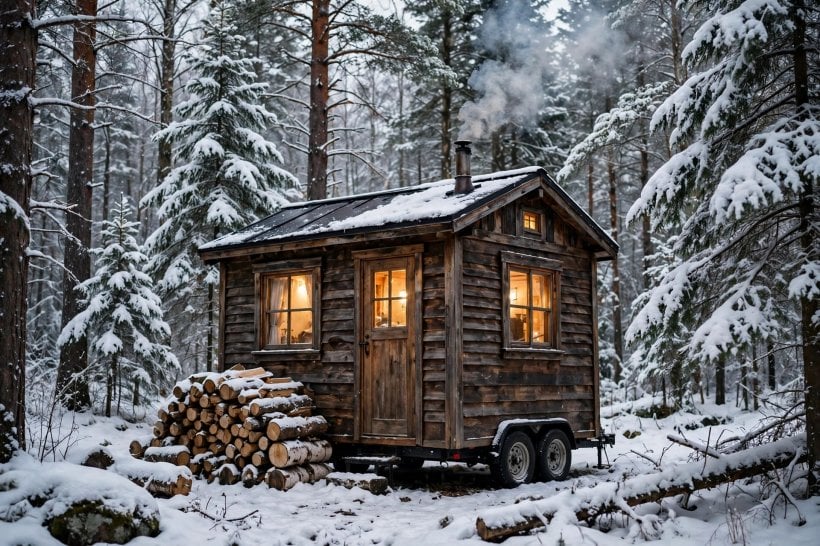
That is why a location quiz earns its place at the start of a tiny house journey rather than the end. Before you compare builders or sketch lofts, it pays to understand the practical landscape of where to park a tiny house and how sharply the rules change from one county line to the next. The five questions below are the five filters that decide whether a region will work for you in real life — not just in a photograph.
3. Question 1 — Climate: The Answer That Weighs the Most
The first question asks you to pick your ideal climate, and it offers four honest extremes: Warm/Hot (“I hate snow. Give me sunshine.”), Cold/Seasonal (“I love seasons and mountains.”), Mild/Temperate (“Goldilocks zone. Not too extreme.”) and Dry/Desert (“Low humidity is my priority.”). There is no neutral option, because the tool’s scoring treats weather as the single most important factor in the match — your climate answer counts for more than any other question you will answer.
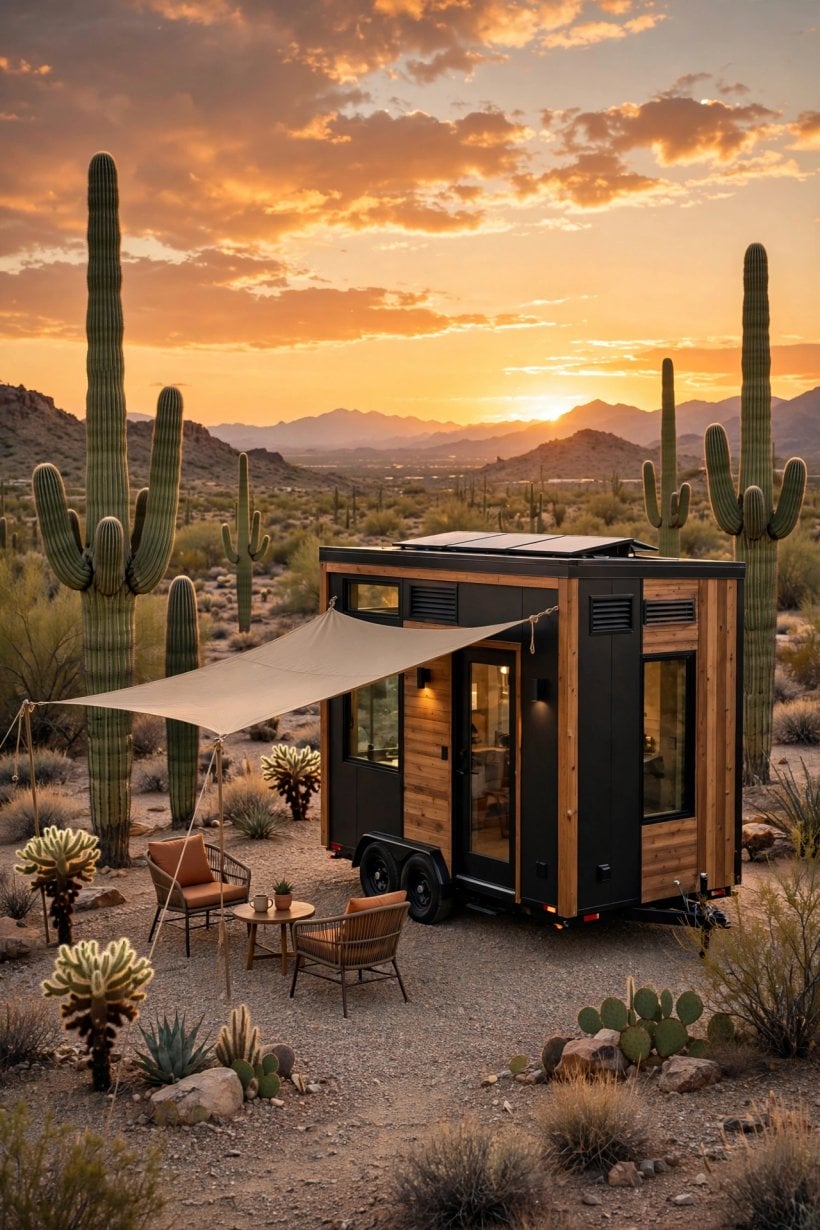
Answer this one from experience, not fantasy. Think about the winters you have actually enjoyed, the summers that drained you, and whether humidity, snow or dry heat is the condition your body complains about most. A tiny house has thin walls and a small interior volume, so outdoor climate reaches you quickly — it shapes your insulation choices, your energy costs and how much of the year your living space effectively extends onto a deck or patio. The region the quiz sends you to will be anchored to this answer, so give it the answer your past self would give.
4. Question 2 — Land Budget: Thrifty, Balanced or Premium
Question two turns to money: what is your land budget strategy? The Thrifty answer wants cheap rural land, with amenities secondary. Balanced means you are willing to pay for some convenience and proximity. Premium means you want a prime spot near a cool city, and cost is secondary. None of these is the “right” answer — they simply point the matcher at very different parts of the map, because the same money buys a wooded acre in one region and a rented pad in another.
Be realistic about what “land budget” includes. Beyond the purchase price or lot rent, a region choice affects hookup costs, commuting and how far you drive for work and supplies — the trade-offs explored in our guide to where you can build a tiny house, including land and zoning basics. If your honest answer is Thrifty, the matcher leans toward affordable rural regions; if it is Premium, it can keep city-adjacent options like Portland in play. Mismatched expectations here are the most common reason a quiz result “feels wrong,” so answer with your real budget, not your aspirational one.
5. Question 3 — Vibe: Deep Nature, Village or Urban
The third question asks, “What’s your vibe?” Deep Nature is privacy and off-grid living. Village is social and shared. Urban is ADU culture and jobs. This is the lifestyle filter, and the scoring weights it second only to climate — because two people can love the same weather and budget and still want opposite lives: one dreaming of a silent homestead, the other of neighbors, shared gardens and a short walk to work.
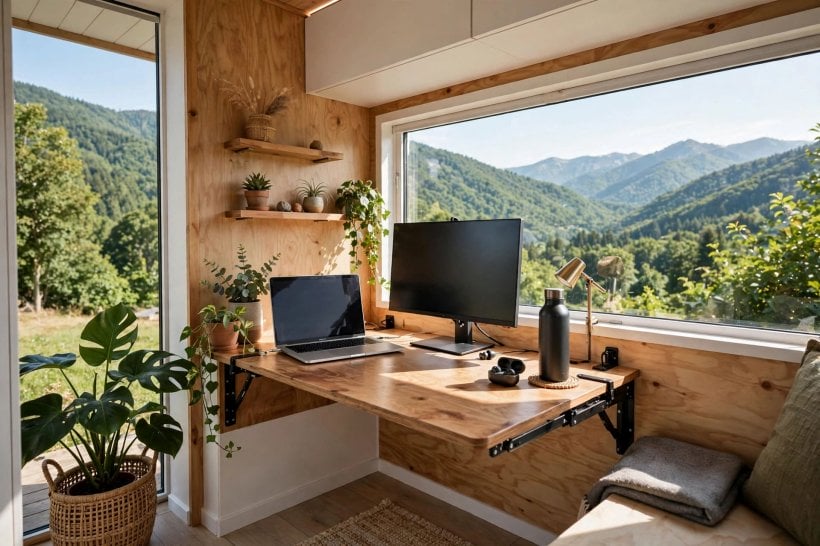
Your vibe answer decides which communities even make sense. Village answers point toward established tiny house communities and villages; Urban answers point toward cities where accessory dwelling units are a normal part of the housing mix; Deep Nature points toward rural regions where land is cheap and enforcement is relaxed. If you are torn between two ways of living, it helps to understand the practical contrasts in tiny house communities vs RV parks — their rules, costs and culture before you answer. Picture an ordinary Tuesday in each setting, and choose the one you would not get tired of.
6. Question 4 — Legality: 100% Legal and Coded, or Under the Radar
Question four is the one many people skip in real life and regret later: legality preference. The first option is 100% Legal & Coded — you need zoning that specifically allows tiny homes. The second is Under the Radar — you are okay with rural areas where rules are ignored. The matcher treats both as legitimate preferences and routes you accordingly: strict answers favor regions with coded or ADU-legal pathways, while flexible answers open up places known for specific friendly zones or lax enforcement.
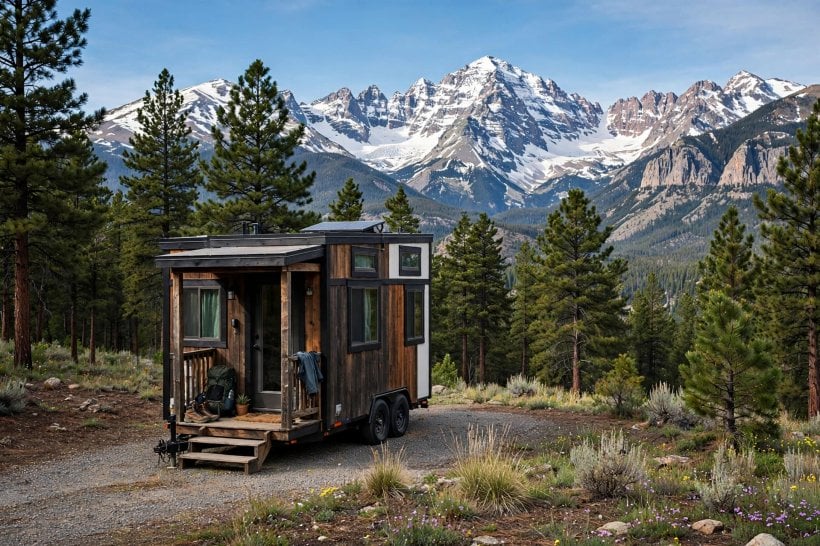
Neither preference is a moral judgment; it is a risk profile. A coded, fully legal placement offers permanence and peace of mind, while an under-the-radar placement often offers freedom and low cost in exchange for uncertainty. Whichever way you lean, go in with your eyes open — our guide to zoning laws for tiny houses and how to talk to local officials shows how to check what a county actually allows before you arrive. Answer the quiz the way you would sign a lease: based on the security you genuinely need to sleep well.
7. Question 5 — Connectivity: Digital Nomad or Flexible with Starlink
The final question is about how you connect. Digital Nomad means you must have fiber or cable — your job depends on it. Flexible/Starlink means you can work with satellite or cell data. This answer carries the lightest weight in the scoring, but it quietly eliminates whole regions for remote workers: a beautiful off-grid county is a poor match if your income arrives over a video call.
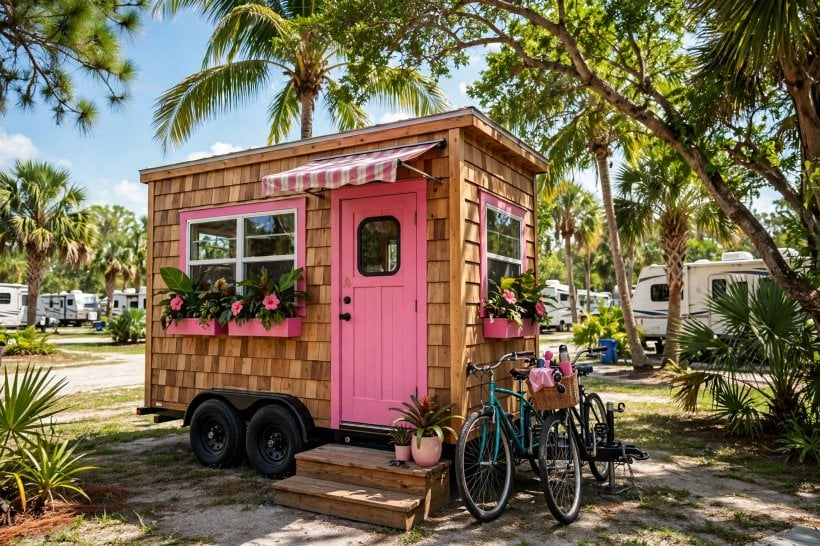
Think of connectivity as part of your utilities package rather than a luxury. The regions in the matcher’s database are tagged by the kind of internet they typically offer — fiber-ready towns on one side, satellite-friendly rural areas on the other — so your answer nudges the result toward places where your work setup will actually function. For a fuller picture of what daily life requires once you land somewhere, see our guide to tiny house utilities, including power, water and off-grid sewage. If your job is remote, answer Digital Nomad without apology; if your life is flexible, the map gets much bigger.
8. Inside the Match Card: How Your Score Is Calculated
When you click “Reveal Location,” the matcher scores all seven regions against your five answers and deals the winner as a Match Card. The scoring is weighted: a climate match is worth the most, lifestyle and budget matches come next, and legality and connectivity matches add smaller boosts. The winning region’s combined score is converted into a compatibility percentage — the card shows it as a match score, capped just shy of a perfect 100% — alongside the region’s name, a short description, its climate, its legality status and key tags such as “Code Friendly,” “High Speed Internet” or “Nature Lover.”
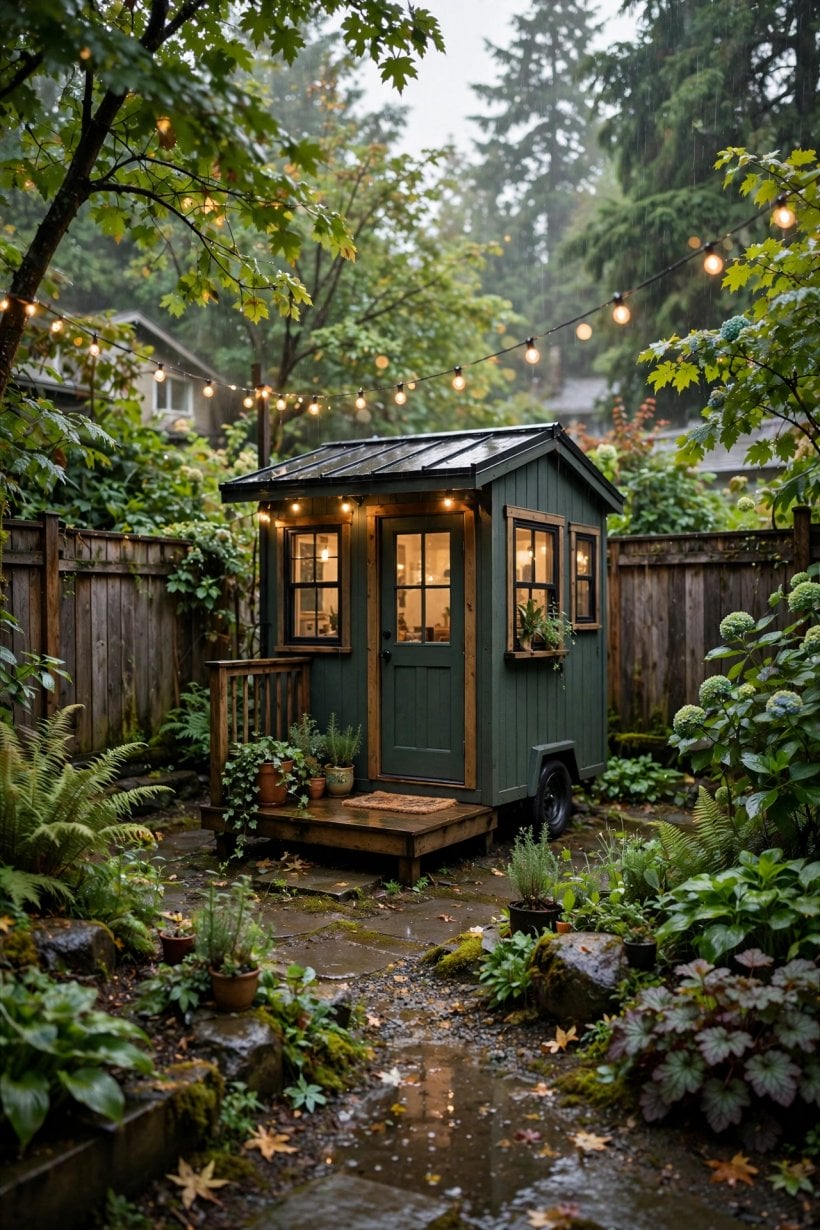
The weights explain why results can surprise you. A region that matches your climate, vibe and budget will usually beat a region that matches everything except the weather — by design, because the tool’s creators judged weather to be the thing people cannot adapt to with money or paperwork. The Match Card also includes a Retake Quiz option, and retaking is genuinely useful: change one answer at a time and watch how the match moves. That sensitivity check tells you which of your preferences is doing the heavy lifting, and which regions sit just behind your winner as strong second choices.
9. The Seven Matches: A Quick Tour of Every Result
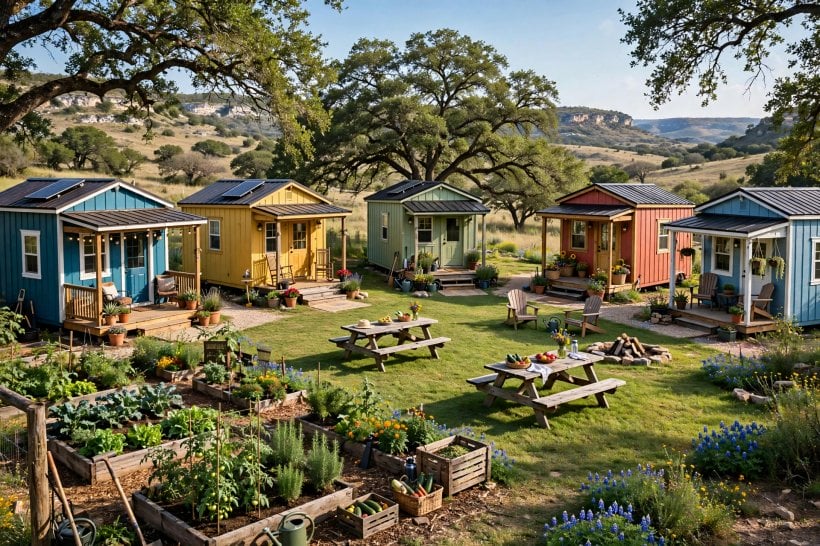
Every result in the database is a real tiny house region with a distinct personality. Asheville, NC is described as the tiny house capital of the East — artsy and progressive, nestled in the Blue Ridge Mountains, and excellent for nature lovers who still want culture; the tiny house communities near Asheville show how established that scene is. Austin and the Hill Country, TX pair warm weather with an incredible food scene and Community First! Village — a strong pick for sun lovers who want community, with plenty to learn from local guidance on where to park a tiny house in Austin.
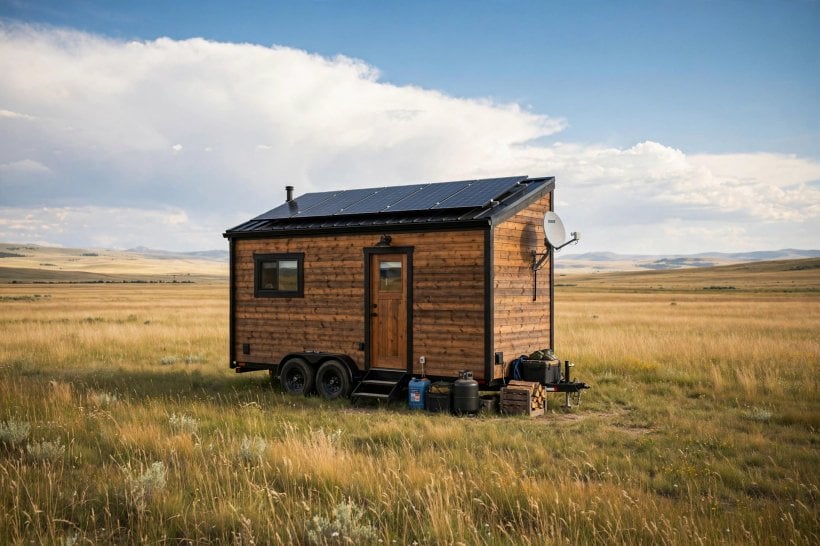
Colorado’s Front Range is the outdoor paradise of the set, for skiers and hikers, where specific towns like Walsenburg are very tiny-friendly — with the honest warning to be prepared for winter. Pima County, AZ is the desert result: dry heat, and some of the most progressive tiny house building codes (Appendix Q) in the USA. Portland, OR is the urban original — park legally in a backyard as an ADU, if you don’t mind rain. Central Florida is the tropical budget play: no snow ever, lots of RV parks that accept tiny homes, and affordable living outside major cities. And Vermont is the homesteader’s match — beautiful seasons and a live-and-let-live attitude, perfect for those seeking deep nature.
10. From Match to Move: What to Verify After Your Result
A quiz result is a compass heading, not a moving truck. Once the matcher names your region, the real research begins — and it follows the same five filters the quiz used. Start with legality: read the county and city rules for your matched region and confirm that your type of tiny house, on wheels or on a foundation, is genuinely permitted where you want to place it. Region-specific guides help here — for example, our breakdown of where you can put a tiny house in Colorado, with legal spots and rules shows the level of detail to look for in any state.
Then verify the lived reality. Visit in the season you claimed to love, not just the flattering one. Check the actual internet options at real addresses, drive the commute your vibe answer assumed, and price the land or lot rents behind your budget answer. If your tiny house living quiz match survives that scrutiny, it was a good match; if it does not, retake the quiz with the answer you now know was wrong — most people find their second result lands closer to home, because the first run taught them what they actually value.
Final Considerations
The Tiny House Location Matcher works because it asks the questions in the right order: climate first, then money, lifestyle, legality and connectivity — the same sequence in which location decisions succeed or fail in real life. Its seven regions are not the only tiny-friendly places in America, but they are a well-spread shortlist: mountains and desert, city backyards and RV parks, coded counties and live-and-let-live countryside. Answer honestly, treat the percentage as a conversation starter rather than a verdict, and use your Match Card as the first page of your research file — not the last.
Tiny House Location Matcher
Ready to find your spot? The matcher is below: click “Find My Spot,” answer the five questions one screen at a time — you can go back and change answers as you go — and then reveal your location. Your Match Card will show your top region, your compatibility score, and the climate and legality profile that earned it. Where should you park? Five honest answers will tell you.
This tool transforms the abstract question “Where should I live?” into a concrete recommendation engine. It analyzes user preferences for Climate, Budget, Legality, and Lifestyle to suggest specific US regions known for being Tiny House friendly (e.g., Asheville, Austin, Colorado, etc.).
It features a “Match Card System” that displays the winning location with a compatibility score and key tags (e.g., “Code Friendly,” “High Speed Internet,” “Nature Lover”).
Tiny House Location Matcher
Answer 5 questions to find your ideal tiny life habitat.


0 Comments