Rock garden ideas for slopes that hold: grade bands from under 15% to over 30%, 3–6 ft terraces with 12–24-inch dry-stack risers founded on undisturbed soil, 1–2% cross-slope drainage to a base swale, and groundcovers at 6–8-inch spacing whose roots reinforce every bed.
Browsing: Live
Liberate your living experience – unlock the boundless potential of off-grid living. Break free from the constraints of conventional housing and embrace a life of unparalleled freedom, simplicity, and regeneration. Craft your sanctuary, where the rhythms of nature harmonize with your deepest desires.
Xeriscaping with rocks and native plants, by the numbers: a 50–75% cut in outdoor water use, 3–4 inches of rock mulch over a woven barrier, 70%+ native planting in drifts of 5–9, drip at 1–2 GPH per perennial — and a garden that runs on rainfall by year three.
Build a rustic log cabin bench in one afternoon: a 5–6 ft half-log seat from a 12–18″ log, ripped by chainsaw in 15–30 minutes, set 17–19″ high on splayed lag-bolted legs, and finished with two coats of linseed oil reapplied yearly.
A rustic log arbor you can build in a weekend: 4–5 ft wide, posts 3 ft deep in gravel, roses and clematis overhead — 15–25 years of service.
Log craft ideas from branches and cutoffs: tea light holders in 20 minutes, coasters, wood cookies, branch shelves and pyrography — small wood, big charm.
Log project ideas for the garden: a half-log bench, hollowed planters, raised log beds and a climbing arbor — built from free logs, finished to last.
Natural rock retaining wall, two ways: dry-stack vs mortared compared — the forces, footings, drainage and build steps that decide which wall wins.
Landscaping rock ideas, compared honestly: lava rock at $80–150 a ton, river pebbles at $40–80, slate at $120–250 — which stone suits your beds and paths.
Front yard rock landscaping for tiny homes: a 4-ft flagstone entry path, 3–4 ft foundation beds with 2–3 boulders each, solar path lights every 6–8 ft, a lawn swap that saves 10,000+ gallons a year — and the $500, $2,000 and $5,000+ makeover tiers.
Rockscape ideas for small yards, scaled bold: a hero boulder at 1/8 to 1/6 of the yard’s longest side, set a third underground, river rock drifts at 2–4 inches over a 3–4-inch gravel canvas — the whole composition phased for $1,000–2,800.
Landscaping with rocks for the high desert: decomposed granite at $3–6/sq ft, boulders grouped in threes and fives, 3–4 inches of gravel mulch, 70% native plants on drip hydrozones, and dry creeks sized for the 100-year storm — a complete tiny lot for $2,000–5,000 that needs 4–6 hours of care a year.
Alpine rock garden design for tiny home lots: excavate 12–18 inches for drainage, build the 50/30/20 gritty mix over a 6-inch rubble reservoir, bury every stone one-third deep in a 1-3-9 arrangement, and plant sedums, saxifraga and dwarf conifers — a complete 6×10 ft mountain bed for $400–$1,100 that asks for 15 minutes of weeding a month.
Vacuum insulated panels explained: R-25 to R-40 in a single inch, where they earn their premium in a tiny house — and the handling rules that protect them.
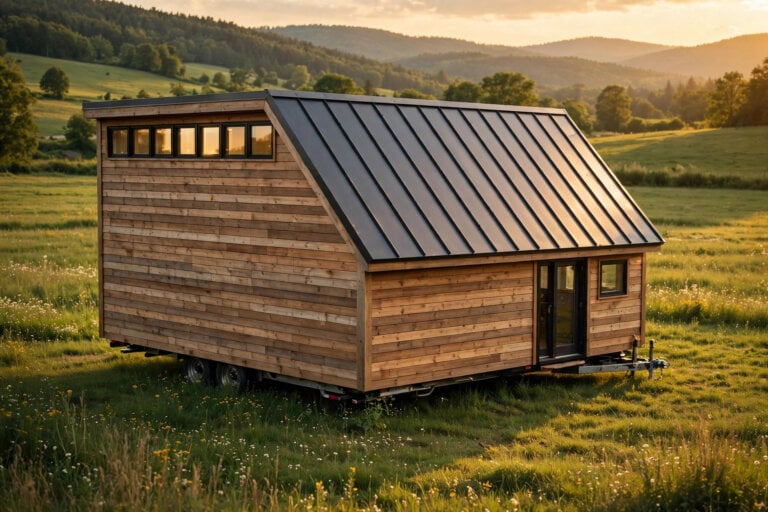
Shed roof tiny house framing, end to end: the 3:12 pitch minimum, the 13’6″ height loop, 2×8 rafters, the tall shear wall, one gutter and standing-seam metal.
Off-grid power stations compared for tiny houses: Jackery, Bluetti and EcoFlow head to head — the 2,048 Wh mid-size class, 2,200–2,400W output, solar input from 800W to 2,400W, LiFePO4 cycle life of 3,000–3,500 cycles, and the 1.5× sizing math that matches the box to your daily load.
Tiny house plumbing layout that works: the one-wall wet wall, 1/4-inch drain slopes, wet venting, a PEX manifold and fast 15-minute winterizing.
How to build a timber frame cabin on a budget: local green timber, three joints, simple pegged bents and a community raising — a frame at 25% of kit cost.
Lightweight interior wall finishes for tiny houses, weighed panel by panel: 1/4-inch plywood at 0.75 lbs/sq ft against drywall’s 1.6, beadboard and hardboard down to 0.4, the 800+ lbs the switch saves — and the glue-and-brad flexible fixing that survives the tow without a cracked seam.
How to seal tiny house sill plates and corners in layers: foam gasket, butyl bead, flashing, taped WRB and flexible sealants that survive the highway.
Shipping container home structural integrity explained: corrugation, corner posts, the under-4-foot rule, moment frames and rust — cut openings safely.
How to prevent tiny house framing from twisting on the highway: shear walls nailed to schedule, hold-downs, a full load path and post-tow checks.
Tiny house skirting options compared: vinyl windbreak panels at $500–1,200, foam-backed insulated metal at R-5 to R-10, and wood and composite at up to $5,000 — plus the R-10 to R-13 cavity foam, 1-per-150 venting and 6-mil ground barrier that keep pipes alive at -20°F.
Propane vs electric in a tiny house, settled by the numbers: 91,500 BTU per gallon against 3,412 per kWh, tank sizing from a 20-lb cylinder to a 96-usable-gallon ASME tank, 50-amp service math, and why the hybrid — propane for heat and hot water, solar for the rest — wins off-grid.
How to install a mini-split in a tiny house: sizing at 20–30 BTU per sq ft, head and condenser placement, line sets, wiring and legal refrigerant options.
Compact kitchen appliances for tiny houses, sized for real cooking: a 24–30-inch sink 8–10 inches deep, a 24-inch apartment range or cooktop-plus-oven pairing, a 10 cu ft fridge on 2–2.5 kWh/day, a 200+ CFM vented hood and 20A circuits planned for a 2,800W peak load.
How to fasten subfloor to a steel trailer — the hybrid system that works: 3/8″ or 1/2″ through-bolts every 4 feet on the perimeter, #12 TEK screws every 12–16″ inside, a sill gasket against corrosion, and the 1.5× edge-distance drilling rule.
Tiny house wind resistance, costed and cured: a Cd of 0.8–1.0, 40–70 extra gallons per 1,000 miles, and the nose, roof and sway fixes that pay it back.
Condensation control in yurts, solved as a system: crown ventilation, a reflective layer, dry heat and daily habits that keep felt and canvas mold-free.
How to choose trailer axles for a 14,000-lb tiny house: GAWR math, torsion vs spring axles, brakes on every axle, ST tires and the bearing routine in full.
Inflatable house structural engineering explained: how 0.5–1.5 inches of water column (0.02–0.05 psi) and a 200–800W blower hold a membrane home up — shapes, anchoring against 2,000+ lbs of uplift, the R-1 insulation fix, snow loads, backup power, codes and the 15–25 year membrane lifespan.